Magdalen Road at night

Magdalen Road at night
December 2010

Tuesday, 6 September 2011

Have you ever looked at the magnolias in St Leonard’s?

Have you ever looked at …

… the magnolias in St Leonard’s?

Last issue, I suggested that you looked at some man-made features of St Leonard’s. With the coming of spring, how about spending time admiring some of the trees? Throughout the neighbourhood, there are numerous spectacular trees. Let’s just focus on one species, which is notable in St Leonard’s at this time of year. Hopefully, when you read this, there will be magnolias in flower.

Magnolias have a special link with our city and the area; it was here that the Veitch family established their nursery, in Queen Victoria’s reign, with land at Gras Lawn. The Veitch nursery introduced many kinds of spring-flowering magnolia from Japan and China, raised from seed brought back by their plant hunters. Their efforts popularised several kinds, and in 1907 produced a hybrid known as Magnolia x Veitchii.

At this time of year, the oriental magnolias are coming into flower. In passing it should be mentioned that the American magnolia, grandiflora, flowers later in the year. There are several of these evergreens in St Leonard’s; there’s a prominent one on the north side of Magdalen Road, just before the junction with Barrack Road. The most popular variety of this tree is called “Exmouth”.

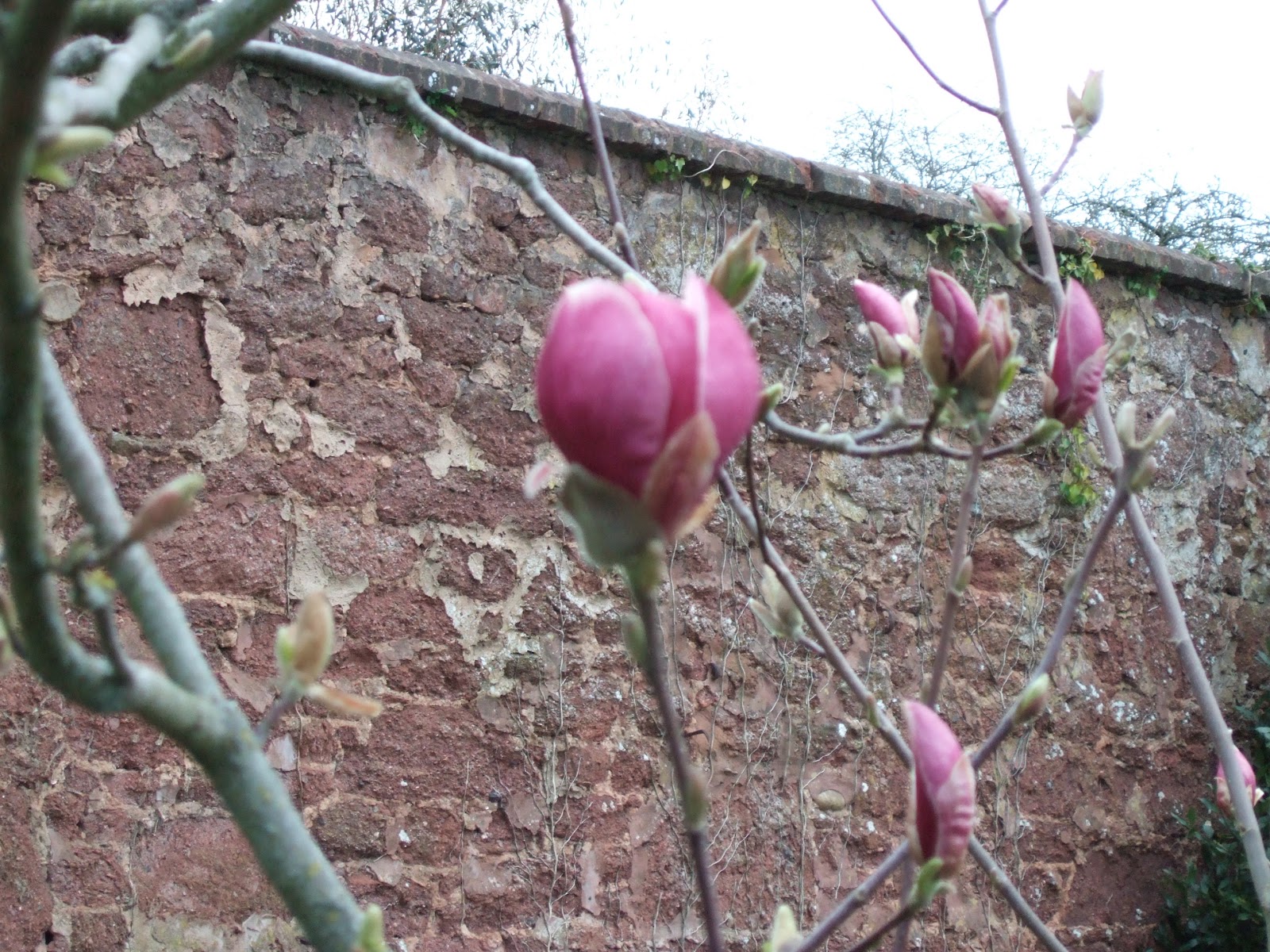
The south-east corner of County Hall grounds is home to several trees which should be flowering in March and April. You may be in time to see the huge pink blossoms of Campbell’s magnolia. It used to come into flower at the end of March, but in recent years the first flowers have appeared earlier and earlier in the year. Provided there has not been a frost to damage the flowers, it is a magnificent sight. As the Michelin Guides say, “Well worth a journey”. (And do remember, the grounds of County Hall are open to anyone to enjoy; I have met people who were under the impression they should keep out.) Magnolia corner, near the main entrance to County Hall has several other examples, flowering through March and April.

There are dozens more to be seen around our streets. For simplicity, most of them can be divided into three principal types. There are the trees whose flowers are shades of white and pink, sitting upright on the branches, and looking like wine glasses. These are cultivars of Magnolia soulangeana. There are trees with floppy white flowers, Magnolia kobus. The third group is made up of bushy, spreading low trees, again with floppy flowers, which may be white or pink. That’s the group of varieties of Magnolia stellata, the star magnolia.

Magnolias take their name from Pierre Magnol, a 17th century French botanist. The soulangeana hybrids were first created by another Frenchman, Etienne Soulange-Bodin in 1820. Kobus comes from Japan. The origin of the stellata varieties is confused, and botanists are not sure if the parent plant is found in the wild, or is the result of hybridising.

Besides a walk to County Hall, there are two short walks from the village to admire numerous examples of this special species. For the first walk, go along St Leonard’s Road, keeping your eyes open for trees of assorted sizes. Turn left into Wonford Road and walk to Lyndhurst Road, follow it up to Penleonard Close and leave by the footpath to Magdalen Road, to return to the village. A little later in spring, try walking along Marlborough Road, left to Lyndhurst Road, and follow it to Victoria Park Road and walk up to Magdalen Road. The second walk includes the sight of several examples of the later-flowering Magnolia lilliflora, one of the parents of the soulangeana hybrids. Their flowers are more like champagne flutes than wine goblets. Whichever walk you take, look out for the sight of pink, purple and white blooms showing over the walls and fences of St Leonard’s. How many different colours can you find?

By the way, magnolia flowers don’t have any petals. Botanically speaking, the plants produce tepals instead. There’s a useless piece of information for your next pub quiz evening!
Magnolia Corner at the entrance to County Hall from Topsham Road
Magnolia in flower in the grounds of County Hall with the wall of Coaver behind

Have you ever looked at the walls of St Leonard's?

Have you ever looked at …

… the walls in St Leonard’s?

Most of us, I suspect, walk through St Leonard’s without looking closely at what we see around us. So, here’s a challenge; have a look at some of the everyday features of our neighbourhood. Let’s start with the walls that form the boundaries of properties here. I was going to say “the front walls of gardens” but there are a variety of walls to see, not all of them are front walls.

Where shall we start? There are high walls and low walls. There are several walls which are only a few centimetres high, just one or two bricks above the level of the pavement. At the other extreme, there is the high wall at the end of Bull Meadow supporting the embankment of Magdalen Street and Western Way. Maybe that doesn’t count as a proper wall, so how about the old wall on the north side of the grounds of County Hall grounds, which were boundaries for the gardens of Coaver House? Is that the highest wall in the area? (Below)

Then look at the materials used to build the walls. You’ll find bricks of various sorts, some old, some new, some hand-made, others turned out in mass production. There are walls which have two or more kinds of brick, and some which are made of modern breeze-blocks. There are stone walls too. And the stone walls are very varied. Some are made of regular blocks, with stones treated as if they were extremely large bricks. Others are built of irregular pieces of stone, carefully fitted together to make a (reasonably) smooth faced structure. The stone is varied. A great number of our local walls are built entirely of Heavitree stone. It was available locally and is easy to work, coming from Wonford or Whipton. However, have a closer look at some of our Heavitree stone walls; motor traffic is not good for them. There are several walls which have been eroded at their base, where rainwater has been splashed up by passing vehicles. They lasted well when everyone travelled at a sedate pace on foot, on horseback or in horse-drawn transport.

In a number of places there are other types of stone used for walls, and in many you will find a variety. The nineteenth century houses in Magdalen Road have walls of harder materials; these were probably more expensive than the sandstone. The mixture reflects the wide range of stone found in the city walls. There’s basalt (also known as trap) which may have come from a quarry at Barley, west of the city. You may find some of the really dark trap from Northernhay, and Pocombe stone from near Crossmead. Pocombe stone is distinctive; it is dark purple, with white veins in it.

Over the years, many walls have been altered. There are several local walls whose base is stone, raised at some stage with courses of brick.

A wall in Wonford Road which shows two phases of construction.  I think the stones have been used to fill an old gateway.


Some walls are rendered; this may be to disguise a cheap material, or to protect the wall from the weather. The wall of Old Matford in Wonford Road is an example of the latter.

The tops of local walls are varied too. Granite has been used in places, but you will find a range of different materials. Tiles, ordinary and special bricks, stones arranged in patterns – all are there. Walls are flat or stepped, and there are a few which have more elaborate patterns, such as the modern wall outside The Lodge in Spicer Road. In St Leonard’s Road, there are walls which show where railings were removed, presumably during the Second World War. Other walls have railings, or the boundary is raised with a hedge or fence. In the next month or so, you will find local walls with flowering bulbs. Gateposts and gateways show more elaborate ways of topping a structure.

In parts of the neighbourhood, you’ll find walls which talk of the past history of the area, where a wall marks the boundary of a building which no longer stands. In Holloway Street, the wall of the churchyard shows traces of the bridge which formerly linked Mount Radford House to the church.

So, have a look around the walls of St Leonard’s, and see what you can find! You may find, as I have, that there is a bird’s nest in one of them. But which wall is my secret!
The wall of Coaver House forms the boundary between 
County Hall campus and gardens in Matford Avenue


Introduction to this blog

In January 2010, the Neighbourhood News for St Leonard's, Exeter, carried a short article which began "Have you ever looked at …?".

I had planned to write six such articles, as the Neighbourhood News appears every two months, and I expected to be able to find enough material for six issues. After a time, I realised that there was more to be written, and several readers encouraged me to write about this attractive district of a most attractive and interesting city. When people asked me for copies, it seemed a good idea to publish them for anyone to read.

If you come from another part of Exeter, or another town or city anywhere, maybe these articles will inspire you to look at your neighbourhood with fresh eyes. If you want to see pictures of St Leonard's, then search with the keywords "Magdalen Road Exeter" for pictures of the "Village".

I hope that you derive as much pleasure reading as I gained from writing. The articles may be copied, but any reproduction must carry the attribution to myself.

To see any of the articles, click on the list of labels on the side of the screen.