Magdalen Road at night

Magdalen Road at night
December 2010
Showing posts with label Matford Avenue. Show all posts

Tuesday, 4 July 2023

A look at the history of Matford Field, Exeter


 At the east of St Leonard's is an area that was once referred to as Matford Field.  It now consists of the land belonging to the houses in Matford Avenue, Leighdene Close, Matford Road, the flats on the east of Matford Lane and the houses in Wonford Road which abut on this.  This is an attempt to describe the history and development of the area, with the aid of maps and pictures.


The history of St Leonard's by Diamond was published in 1873.  The book included a map showing the church parish 100 years earlier.  Madford Lane curves round to become Wonford Road and leads to Great Madford House (now Old Matford).  Oddly, Bellair is not shown.  The area of Matford Field is blank.

Diamond's second map shows several changes in 100 years.

 
It now shows Bellair and Coaver to the south, the Veitch family home near Barrack Road, and many more houses along Lyndhurst Road, Wonford Road, Victoria Park Road.  There is still no development on Matford Field, as can be seen in the earliest large-scale OS map that I have found online.  In this, as in some other pictures, I have shown the map alongside the image from Google Earth


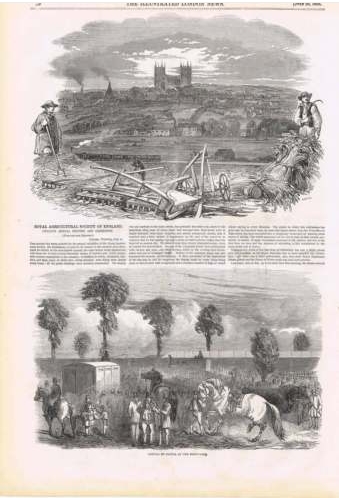
This shows a field division and I have found the two fields with names Matford Great Field and Matford Field.  These two fields were used for the July 1850, the Royal Agricultural Society of Great Britain annual show, which I have described earlier
http://lookatstls.blogspot.com/search/label/Agricultural%20Show

The two fields were covered with wooden sheds for animals and the latest developments in agricultural equipment.  Afterwards there was an auction of fence materials and the wooden sheds --- recycling is not a modern idea, and possibly, the scrap materials from this show were handled in a better way than after some 21st century events where the priority is to get rid of things!


The next reference to the area comes with it being used for rugby, by Exeter's team, at the end of the 1880's.  It appears that there were no facilities for changing and teams changed at a hotel in South Street!

In 1892, an auction was advertised, by which time the road layout had been planned.  Here is the cover of the auction and the accompanying map.


However, at very short notice, the sale was cancelled.  As can be seen from the map, there were now two houses on Matford Field, either side of Matford Road, at the junction with Wonford Road.

These had not appeared on another Victorian OS map, from about 1874, but the Great Field is now shown as an orchard, and the area to the east (Deepdene Close now) is Nursery and the grounds of Old Matford.


At some time after the cancelled sale, four houses were built on the east of Matford Avenue, on the boundary of what became Deepdene Close.  I have found a request for a servant in one of the houses dated from 1913.  Three of those houses stand today.  The fourth was called Deepdene, and the houses of Leighdene Close are built on the large garden of this house.  (I will refer to it as Deepdene House, to prevent confusion with the present private road, Deepdene Close. 


The four houses appear in the map from 1905 along with the coach house on Wonford Road, and Oakdene on the corner of Matford Road and Matford Avenue.  Two plots have been marked out on the east side of Matford Road

More houses were built along Wonford Road, Matford Road and Matford Avenue between the wars.  The map below is dated 1932 and shows the outline of the houses numbers 25,27,29 and 31 in Matford Avenue.  The same two plots are marked in Matford Road, but are not developed.  But The Gables in Matford Road is there.  Deepdene's garden has grown, expanding towards the east and south with formal paths and (possibly) a glasshouse.  There houses and bungalows on the western arm of Matford Avenue.


The map below shows the area in about 1935.  Copies of this map were used (overprinted in German) by the bombers in Exeter's Blitz
 

There are some odd aspects to the housing in this map.  The former Lord Mamhead Homes has a strange garden shape using several plots from the 1892 sale map.  Its neighbour to the south does not fit into any of those plots.  A very strange curved boundary is shown for the original house at the north end of Matford Avenue, fronting Wonford Road.  The large garden of Deepdene appears divided internally, with a strange deviation from the 1892 plots to accommodate a house in what is now Deepdene Park.  The Matford Lane end of Matford Avenue is shown as parkland adjacent to Coaver.  The southern arm of Matford Avenue has been developed.  

And there is a tennis court in the angle of Matford Avenue.  At some stage, the Vicars Choral of Exeter Cathedral (disbanded in the early 1930s) had owned much of old Matford Field as a recreational area, and their financial records show that local house-owners had to pay compensation for "loss of amenity" to this organisation.  (That odd charge remains in the title deeds of several houses.)   Watch out below for the tennis court!

During the blitz, some bombs fell in the area, and the records for May 1942 show a death in Matford Lane, but no mention of bombs in the area, although this is when --- supposedly --- Deepdene House was destroyed by a firebomb and other houses were damaged.  

After the war, the RAF took aerial photographs of much of Britain.  Here are some:

That's dated 30th September 1945 and shows the tennis court and a formal garden to the east of the ruins of Deepdene House, along with new houses in Deepdene Close. 

 
8th July 1946 

10th June 1947 showing some areas which look like allotments at the west end of Matford Avenue

20th February 1957 --- the tennis court has gone, ready for new houses; Deepdene House gardens are being cleared.

26th July 1963; rather indistinct but the outline of Leighdene Close is clear; work is in progress on building County Hall.

And now:


Saturday, 8 March 2014

Have you ever looked at the hedges in St Leonard’s?


If the Tardis carried you back to St Leonard’s in the eighteenth century or earlier, the roads of our neighbourhood would be lined with hedges, to protect the local farmers’ livestock from travellers, and vice versa.  So our oldest roads, Wonford Road, Heavitree Road, Magdalen Road, Topsham Road and Matford Lane would have been muddy tracks with a hedgerow and stone walls on each side, interspersed with gates and farm buildings.  Those hedges would have been like many in rural Devon, a dense barrier of native trees and shrubs, tended by regular cutting and periodic hedge-laying, with hand-tools, of course.  There is a modern example of hedge-laying at the further end of Bromhams Farm football field.
 
At the junction of Matford Lane and Wonford Road the hedge is a survivor from the old hedgebank, hidden behind the scrub.
The nineteenth century saw parts of these roads being developed for houses, with the loss of most of the ancient hedges, though boundaries followed the old lines.  But the houses that were built needed to mark their boundaries, and new hedges were planted.  Unfortunately, it is hard to date when local hedges were planted, but some have been with us for a century or more.  (In rural areas, there are rules of thumb for estimating the age of a hedgerow, based on the number of species of tree in a given length, but those rules don’t work in towns and cities.)

The process has continued to the present day, with many more recent household boundaries marked by hedges on their own, or with walls or fences.  It seems strange, since a hedge demands more maintenance than a fence or wall does, but hedges give us a link back to the rural past, and have many other benefits as well. 
A section of wall with hedge on top (Wonford Road)
So let’s look at some of the hedges that can be seen around St Leonard’s.  We have a few examples of a countryside hedgebank in an urban setting, that is, an earth bank planted with trees like hawthorn, with their trunks laid to be almost horizontal.  Much more common in the city are hedges on top of stone or brick walls, so that the boundary is marked in a permanent way, but it looks as if the boundary is a part of the garden, a living backdrop for all the flowers and shrubs.  And we have hedges which grow alongside fences and railings, serving the same aesthetic purpose.  If you are playing I-Spy, give yourself 10 points for a hedge with a wall, fence or railings, 25 points for a hedge with two other barriers, and 100 points for four or more.

Now look more closely, and you will see how every hedge displays some individuality.  First, what kind of tree has been planted?  Is there one species, or two, or more?  Are they mixed in a systematic way?  When I was researching this, I came across a hedge that is being repaired where the side facing the road has been planted with a row of one species of tree, and the side facing the garden with a second.  A mixture may also be the result of new species colonising the hedge, as happens on farms, and provides the basis for estimating the age of the hedge.  Privet is a popular choice of tree, with laurel and holly as alternative evergreens.  There are several beech hedges, liked because the leaves turn brown in the autumn and are only shed in the spring.  There’s a fine example at County Hall.  One or two gardens have more exotic hedges, using flowering shrubs such as roses (10 points for one of these).  And, yes, we have some hedges of the fast-growing, notorious, and very thirsty, Leyland Cypress.  
Beech hedge at County Hall
Second, how is the hedge tended?  Is it cared for?  After two or three years of neglect, the hedgerow trees start to look less like a hedge and more like a wilderness.  If it is cared for, then has it been trimmed with geometrical precision to look like a wall?  Or does it have some curving shape or irregularity?  Does the hedge match the hedges on either side?  Or have different owners imposed individual styles on theirs?  You’ll find high hedges and low hedges along local streets, creating an interesting urban landscape.  Maybe that is what inspired an estate agent to advertise with the line: "Set amidst the grand avenues of Exeter's premier residential district".

Then, is it really a hedge, or a hedge-like boundary?  In suburban gardens many of us prefer variety to monotony, so mark the boundary with several shrubs or small trees, cut to the rough shape of a hedge, but really forming a harmonious backdrop to the planting of the garden.  Look out for front gardens which are marked by a row of trimmed shrubs of assorted species.  When I came to live in this area, an older resident apologised to me for the shape of one of his front garden shrubs, which he had trimmed into the shape of a cube.  But instead of having edges which were horizontal and vertical, it leaned at a marked angle.  He said that, twenty years on, it was still recovering from the effects of the 1962-63 winter, when the weight of snow had bowed the main trunk. 

Hedges can divide gardens into rooms, as happens in many country houses.  On a smaller scale, car parks are often hidden behind hedges, as happens on the St Luke’s campus.  Not only do the trees screen the vehicles, but they help reduce pollution.   
 
A low hedge to mark the boundary of a car park, County Hall

There are hedges on the hospital site for the same reason.  The offices next to the Crown Court have a low hedge for another reason; it protects the wall from careless parking.  An extension to the concept of hedges marking rooms is to create windows and doors (25 points for finding one).  One example of the latter is at County Hall, and there are others on private houses in St Leonard’s; look out for them.
A doorway or arch through a hedge (County Hall/Matford Avenue)
Besides their aesthetic interest, hedges are havens for wildlife.  Birds nest in our hedges, so if you have a hedge, please don’t cut it when there are likely to be nesting birds hidden in the greenery.  They provide corridors around the neighbourhood for a variety of animals, hedgehogs, squirrels, foxes and rodents.  Frogs, toads and newts can be found in them, along with the occasional snake or slowworm.  Butterflies feed on the hedges, and lay their eggs on some species.

Last, but not least, when we are looking for trimmed hedges and bushes, there are a few examples of topiary in the front gardens of the neighbourhood.  One is in Magdalen Road.  Go and find it!