Magdalen Road at night

Magdalen Road at night
December 2010
Showing posts with label Matford Field. Show all posts

Tuesday, 4 July 2023

A look at the history of Matford Field, Exeter


 At the east of St Leonard's is an area that was once referred to as Matford Field.  It now consists of the land belonging to the houses in Matford Avenue, Leighdene Close, Matford Road, the flats on the east of Matford Lane and the houses in Wonford Road which abut on this.  This is an attempt to describe the history and development of the area, with the aid of maps and pictures.


The history of St Leonard's by Diamond was published in 1873.  The book included a map showing the church parish 100 years earlier.  Madford Lane curves round to become Wonford Road and leads to Great Madford House (now Old Matford).  Oddly, Bellair is not shown.  The area of Matford Field is blank.

Diamond's second map shows several changes in 100 years.

 
It now shows Bellair and Coaver to the south, the Veitch family home near Barrack Road, and many more houses along Lyndhurst Road, Wonford Road, Victoria Park Road.  There is still no development on Matford Field, as can be seen in the earliest large-scale OS map that I have found online.  In this, as in some other pictures, I have shown the map alongside the image from Google Earth


This shows a field division and I have found the two fields with names Matford Great Field and Matford Field.  These two fields were used for the July 1850, the Royal Agricultural Society of Great Britain annual show, which I have described earlier
http://lookatstls.blogspot.com/search/label/Agricultural%20Show

The two fields were covered with wooden sheds for animals and the latest developments in agricultural equipment.  Afterwards there was an auction of fence materials and the wooden sheds --- recycling is not a modern idea, and possibly, the scrap materials from this show were handled in a better way than after some 21st century events where the priority is to get rid of things!


The next reference to the area comes with it being used for rugby, by Exeter's team, at the end of the 1880's.  It appears that there were no facilities for changing and teams changed at a hotel in South Street!

In 1892, an auction was advertised, by which time the road layout had been planned.  Here is the cover of the auction and the accompanying map.


However, at very short notice, the sale was cancelled.  As can be seen from the map, there were now two houses on Matford Field, either side of Matford Road, at the junction with Wonford Road.

These had not appeared on another Victorian OS map, from about 1874, but the Great Field is now shown as an orchard, and the area to the east (Deepdene Close now) is Nursery and the grounds of Old Matford.


At some time after the cancelled sale, four houses were built on the east of Matford Avenue, on the boundary of what became Deepdene Close.  I have found a request for a servant in one of the houses dated from 1913.  Three of those houses stand today.  The fourth was called Deepdene, and the houses of Leighdene Close are built on the large garden of this house.  (I will refer to it as Deepdene House, to prevent confusion with the present private road, Deepdene Close. 


The four houses appear in the map from 1905 along with the coach house on Wonford Road, and Oakdene on the corner of Matford Road and Matford Avenue.  Two plots have been marked out on the east side of Matford Road

More houses were built along Wonford Road, Matford Road and Matford Avenue between the wars.  The map below is dated 1932 and shows the outline of the houses numbers 25,27,29 and 31 in Matford Avenue.  The same two plots are marked in Matford Road, but are not developed.  But The Gables in Matford Road is there.  Deepdene's garden has grown, expanding towards the east and south with formal paths and (possibly) a glasshouse.  There houses and bungalows on the western arm of Matford Avenue.


The map below shows the area in about 1935.  Copies of this map were used (overprinted in German) by the bombers in Exeter's Blitz
 

There are some odd aspects to the housing in this map.  The former Lord Mamhead Homes has a strange garden shape using several plots from the 1892 sale map.  Its neighbour to the south does not fit into any of those plots.  A very strange curved boundary is shown for the original house at the north end of Matford Avenue, fronting Wonford Road.  The large garden of Deepdene appears divided internally, with a strange deviation from the 1892 plots to accommodate a house in what is now Deepdene Park.  The Matford Lane end of Matford Avenue is shown as parkland adjacent to Coaver.  The southern arm of Matford Avenue has been developed.  

And there is a tennis court in the angle of Matford Avenue.  At some stage, the Vicars Choral of Exeter Cathedral (disbanded in the early 1930s) had owned much of old Matford Field as a recreational area, and their financial records show that local house-owners had to pay compensation for "loss of amenity" to this organisation.  (That odd charge remains in the title deeds of several houses.)   Watch out below for the tennis court!

During the blitz, some bombs fell in the area, and the records for May 1942 show a death in Matford Lane, but no mention of bombs in the area, although this is when --- supposedly --- Deepdene House was destroyed by a firebomb and other houses were damaged.  

After the war, the RAF took aerial photographs of much of Britain.  Here are some:

That's dated 30th September 1945 and shows the tennis court and a formal garden to the east of the ruins of Deepdene House, along with new houses in Deepdene Close. 

 
8th July 1946 

10th June 1947 showing some areas which look like allotments at the west end of Matford Avenue

20th February 1957 --- the tennis court has gone, ready for new houses; Deepdene House gardens are being cleared.

26th July 1963; rather indistinct but the outline of Leighdene Close is clear; work is in progress on building County Hall.

And now:


Monday, 20 January 2014

The Victorian revolution in St Leonard’s


According to Robert Newton, author of the book “Victorian Exeter”, 1850 was a turning point in the history of the city of Exeter.  His book examines the economic, social and political development of the city from the 1830s to the turn of the century.  He found several reasons for the importance of the year, and drew attention to one particular event as crucial to the revolution.

And it happened in St Leonard’s.  Our revolution was not a violent one, although some blood was shed.  In July 1850, the Royal Agricultural Society of Great Britain held its annual show in our neighbourhood.  At the time, St Leonard’s was growing as a desirable place to live, but there were still many fields, smallholdings, nurseries and small estates around the large houses.  The Society showground was on a field bounded by Matford Lane to the west, and Wonford Road to the north; both these roads existed at the time.  The southern boundary was the edge of the Coaver estate, roughly where there is now an access road to County Hall from Matford Lane, and extended to the line of the road into Deepdene Park.  At the time this was a field called “Sixteen Acres”.  Later in the 19th century it was referred to as Matford Field.  Today, Matford Road and Matford Avenue occupy the field.  For centuries, this area was in Heavitree parish.  Changes to the parish boundaries were made in the 19th century to bring it into St Leonard’s parish. 

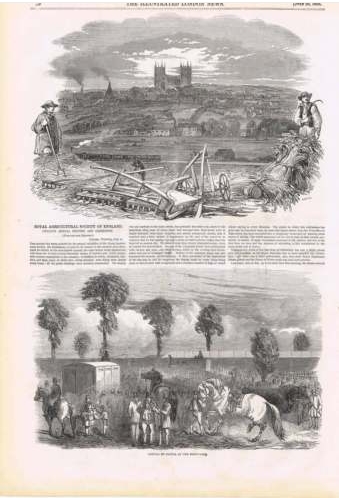
Holding a national agricultural show in Exeter seems to have been an important element in Exeter’s transition from a small provincial town to a city of national importance.  The city was on the map.  People travelled to Exeter from all over the country to attend and to display both their animals and their inventions.  The weekly newspaper, the Exeter Flying Post, issued a special supplement for the show, which listed many important visitors and where they were staying.  With a view to publicity, the newspaper could be sent to anywhere in the country in exchange for five postage stamps (5 old pence).  The Illustrated London News, which circulated across the empire, reported the event with a fanciful picture of a farm worker silhouetted against a vista of the city, alongside portraits of the prize bulls, and a sketch of one of the celebration arches put up in the city to welcome visitors. 
From the "Illustrated London News"
In the previous decade, communications between Exeter and the rest of the country had improved enormously.  The railway had reached Exeter, and in 1850 the first excursion train came to the city.  The city’s economy was changing too, with councillors who were committed to putting Exeter onto the national stage, and developing industries such as papermaking and iron foundries.  Piped water had come to the neighbourhood in 1833, followed by gas three years later, and improved sewage in the 1840s. 

The displays of agricultural equipment on the Matford Lane site were a foretaste of the show in the Great Exhibition in Hyde Park the following year.  New designs of mass-produced plough featured in the sixteen sheds of implements; numerous steam engines were displayed, ready to be connected to the latest designs of farmers’ machinery.  Show animals came from all over England for the event, and there were fourteen sheds for them, each about 250 feet long.  For the intellectual visitors, Professor Simonds of the Royal Veterinary College gave a lecture on “The Structure, Functions and Diseases of the Liver in Domesticated Animals”.  Gripping stuff!
The journal of the RAS included a report on the Exeter show, including this splendid device used for testing threshing machines.  (Every home should have one!)
 If that was not of interest to you, there were other events in St Leonard’s to delight the visitor.  The Veitch nurseries, further east along Wonford Road, were open to visitors from 6am to 6pm every day.  In a field opposite Parker’s Well House (presumably on the Royal Academy for the Deaf site), there was a circus all week.  The Grand American Circus boasted an Equestrian Troupe of Ladies; tickets were 2 shillings for first class seats, 1 shilling for second class tickets, and 6 pence for a promenade ticket.  Children were half price for the seats.  The grounds of Mount Radford House were open to visitors as well, since the Devon and Exeter Botanical and Horticultural Society was staging an “Extra Grand Horticultural Fete”.  This would cost you a little more than the circus, at half-a-crown for adults.  (The organisers drew attention to the fact that there was special provision for carriages.)  Tickets for the Grand Agricultural Ball cost a tear-jerking eight shillings each.

More ominously, the newspaper reported that a “swell mob” of criminals was expected to descend on Exeter for the show – so a crack squad of policemen came from London to deal with the potential problem.

Robert Newton claimed that from 1850 onwards, Exeter’s status in the United Kingdom started to improve.  We in the neighbourhood can be proud that we hosted the revolution which contributed to this.  It was almost bloodless; the only blood which was shed was of farm animals, sold to Exeter butchers.

Print of the prize-winning cattle at the show (Illustrated London News)
Today there is no trace of the show.  The temporary half-mile long boundary fence was quickly taken down, along with thirty sheds and other buildings, and the field returned to pasture.  Fifty years later, new roads were made, the first seven houses were erected on the field, five of which still stand (two were destroyed in 1942), and others have been added since.  In 2008 it was added to the conservation area.  But there is still an open space used by the 1850 show for you and I to enjoy.  It is a corner of the County Hall campus in the corner of Matford Land and Matford Avenue.  There’s a notice to ban “organised ball games”, but nothing banning an agricultural show.  Now, I wonder …!


In the Neighbourhood News, Jan-Feb2015

Addition in January 2017
I have just come across "Putting on a show: the Royal Agricultural Society of England and the Victorian town,c.1840–1876" by Louise Miskell in Agricultural History Review vol 60 pages 37-59

This refers to the Exeter show in several places: she writes: "When Exeter was overlooked in favour of Plymouth in 1865 it was a snub that still rankled, even ten years later when it was recalled that the decision had been arrived at, ‘notwithstanding all that could be urged in favour of the unmistakable and unchallengeable claims of the Cathedral city of the Diocese’. (quoting from Trewman’s Exeter Flying Post, 14 July 1875

There was also controversy about mixing politics with the agricultural show.  "At Exeter in 1850, for example, the organization of a ‘political and Protectionist dinner’ during show week invoked  disapproval in the liberal London press. The Morning Chronicle’s correspondent noted that, ‘Any event which would have the effect of mixing up a purely agricultural society with party politics is, in the opinion of the principal members of the Royal Agricultural Society, much to be deplored’. The editors of the Mark Lane Express, in contrast, gave generous coverage to the ‘Grand Protectionist Banquet at  Exeter’ and to the anti-Free Trade rhetoric of the speakers in its special supplement, published to cover the events of the Exeter show."

She also gives some statistics about the show: It cost the RAS £6570 to put on the show in Exeter, and receipts were £4941, meaning a loss of £1629.  A total of  1223 implements and 619 livestock were exhibited; sadly, her sources did not give the attendance figures