Magdalen Road at night

Magdalen Road at night
December 2010
Showing posts with label Magdalen Road. Show all posts

Tuesday, 19 March 2024

A walk along the walls, part 8


In the last issue, I included the sentence: ‘If another writer took you by the hand, for a walk around our neighbourhood, they might point out other “things”.’  I took that advice and on New Year’s Day, when I walked this route, I looked out for any wild plants that were in flower in the edge of the roads and pavements, spared from weedkiller.  There were six species flowering; a month later, there were two or three more, but far more greenery as plants put out their leaves. So my other “things” were wildflowers.

This walk starts in Magdalen Road, and we wander down towards the city, turning into Fairpark Road.  The lower part of Magdalen Road is lined on the right with the wall of the almshouses, very attractive stonework.  On the left, the scene is mixed, as houses have been built at different times.  Because the walls here are north-facing and are exposed to the weather and spray from the road, the stone supports lichens, mosses and other plants. 

Once in Fairpark Road, the walls are neat and do not show many signs of change.  Then wander down the steep passageway on the right. The buildings on the right occupy the site of the St Mary Magdalene Hospital, a hospital for lepers built in the 12th century.  And that ancient building is why Magdalen Road and Magdalen Street got their names, though the final “e” in the hospital name got lost over the years.  The wall on the right of the passage is somewhat plain; on the left, there is a field wall from the 19th century, using the ubiquitous sandstone.  Below that are walls that date from the building of Temple Road at the foot of the slope.  Once again, the walls support a variety of plant life.  The north wall of Bull Meadow is part of the support of the viaduct across the valley, and is faced with mixed stone.  The viaduct opened soon after Queen Victoria’s accession; the people of Exeter were complaining about the difficulty of crossing the valley, and it is likely that the residents of new houses in St Leonard’s were among the voices calling for change. 

Close to the city, the walls of the two old cemeteries are a confusion of brick and stone, with additions to old field walls topped with brick.  The site of the leper hospital was an orchard until the early 20th century, and the story of how the area became a public park is one of squabbles between local people and the City Council.  It is detailed online as a page of Exeter Memories.

Walking away from the viaduct takes you to the boundaries of the houses in several streets, the back of the former school (now a place of worship) and the back of the Bull Meadow Clinic, an interesting example of 1920’s architecture when it was built as an “Infant Welfare Centre”.  There is a gap which leads into Lansdowne Terrace, whose ten houses date from the mid-19th century.  As you walk along, there is one set of railings which escaped being salvaged in the Second World War.  Since the terraced houses below Lansdowne Terrace are much later, we can only imagine the semi-rural view that the first residents enjoyed.

This brings you to Holloway Street; now you can walk back to your start through the terraced streets, or retrace your walk through the park.  But before you do, look at the junction with Roberts Road.  Anything odd?  There is a line of paving across the road, a relic of a much older road surface.


Tuesday, 4 July 2023

Magdalen Road street event on July 1st 2023

 For the afternoon of Saturday July 1st 2023, the road by the shops was closed and the space filled with craft stalls, food stalls, a band and lots of happy people.  Here are some reminders.


Monday, 3 December 2018

Saturday, 3 December 2016

Magdalen Road Christmas Fair 2016

Magdalen Road was closed for the afternoon of Saturday 3rd December 2016 for the annual Christmas Fair

Announced for passers-by to see
The road was closed from the traffic lights ...

... to the junction with Denmark Road
In between were rows of stalls,

more stalls,

and more stalls,

and some were brightly coloured

The local shops had their own stalls

True to its ethical roots, Leela reused an old display stand for its socks

The panettone was imported; the apricot harvest in St Leonard's was a little sparse

Fish in a roll - enough to feed 5,000?

St Leonard's church offered DIY Christmas Cards

Bright decoration

Street entertainment

Getting into the Christmas spirit; lots of Christmas jumpers were on show

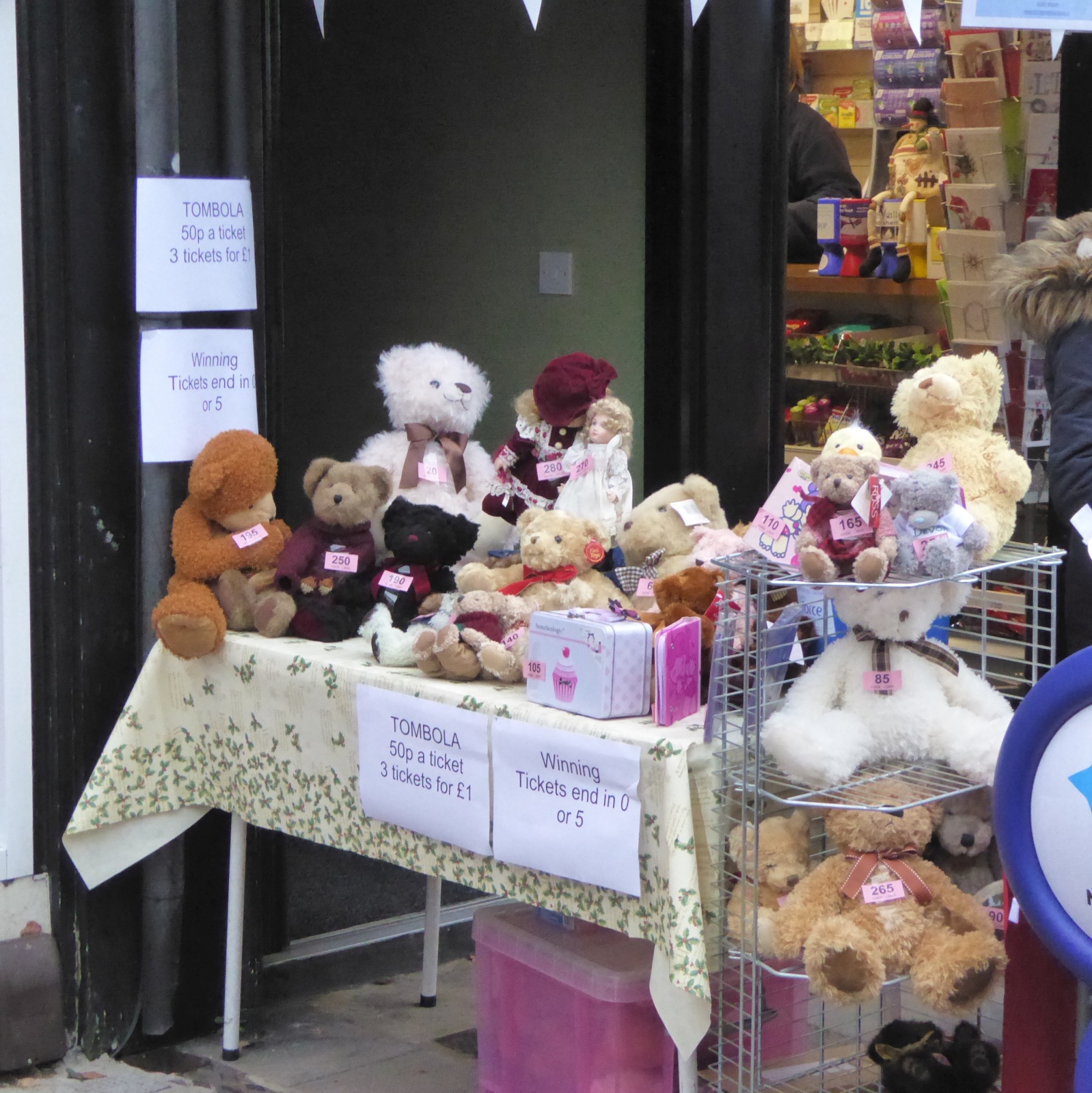
Soft toys on sale

... and children's clothes.

Delicatessen delights

Tombola

Mulled wine
Stop, admire cards, and visit the shop to look at clocks

Stall-holders had bright hats

and so did shoppers and the stalls; it was a cold afternoon


So you might like some mulled wine
 
... or hot chocolate.

Even the ATM did a roaring trade!

Pink and purple colours were in fashion at Oliver's Bakery

and in the Advent socks


One of the many craft stalls

Empty chairs - not for long!

Colourful crafts and backpacks

Saturday, 19 November 2016

Have you ever noticed blank and bricked-up windows in St Leonard’s?


Do you remember, from school, hearing about the window tax?  It was one of those odd snippets that was slipped into history lessons (no disrespect to history teachers!), when we learnt about the unusual tax imposed at the end of the seventeenth century, running in various forms until the middle of the nineteenth.  Householders paid an annual tax according to the number of windows in their house, and the rate rose in sharp steps as the count reached particular thresholds.  So, according to the school-teachers, people bricked-up their windows to reduce their tax.  (There is nothing new about tax avoidance, is there?)  And, to embellish the story, my teacher assured the class that some houses had the space painted black with white lines to represent the panes and window frame.  

There is plenty of evidence that windows really were blocked to avoid excessive tax.  In an interesting story, there is a house on the Scottish coast, which was owned by a businessman and part-time smuggler; the owner bricked up some windows and covered the recesses to make concealed storage space.  And the eighteenth century novel, Tom Jones, refers to the practice when the innkeeper’s wife complains “It is a dreadful thing to pay as we do. Why now, there is above forty shillings for window lights, and yet we have stopt up all we could: we have almost blinded the house, I am sure”.

So can you find examples of house-owners avoiding the window tax in this neighbourhood?  Yes, and no.  The tax was repealed in 1851, when the rate of taxation had not been changed for over 25 years.  So the builders of the majority of early nineteenth century homes in the area knew the tax rate and designed their houses accordingly.  As a result, we have a number of houses which were built with window recesses for aesthetic reasons, but these were never constructed as windows for illumination.  There are houses in Friars Walk like this, dating from about 1840, when English architecture went through a period of celebrating all things Greek.  Those houses share another reason for having blind (blind being the architectural term for an apparent opening) windows; the houses are semi-detached, with two recesses in the middle (front and back) which could never be used as windows because they would be half in one house and half in the other.  There are further examples of this aesthetic deceit in the village, used to give the impression that there was one house when there are really two.  More are found in Baring Crescent and Lyndhurst Road, and at the ends of The Quadrant.  Houses in Victoria Park Road have windows where the semi-circle at the top of a fancy window is blind, and the glazed section is rectangular.  In the same road there are window recesses where the only view would be of next door’s side wall.  In Topsham, one of the listed buildings in Higher Shapter Street has the recesses painted black with glazed sash windows outside.

Spot the false windows in Topsham; photo from geograph.org.uk

It wasn’t just the builders of the fashionable houses for the wealthy which had blind windows; the early nineteenth century terraced homes of Colleton Hill include examples and more can be found in Radford Road and Roberts Road.  

More recently, openings for windows and doors have been bricked up because of changes to the interior of the house.  I mentioned one blocked door in an article in the Neighbourhood News earlier in 2016, where the former doorway opened onto Magdalen Road from a garden in Baring Crescent.  That opening was closed for security.  Unless the builder is very careful, the bricks used for closing the gap will not match and the change will be evident to passers-by.  Can you find examples?  Some of the former shops in Roberts Road had their large windows reduced in size when they ceased to be businesses – and this was for reasons of taxation, to avoid business rates. 

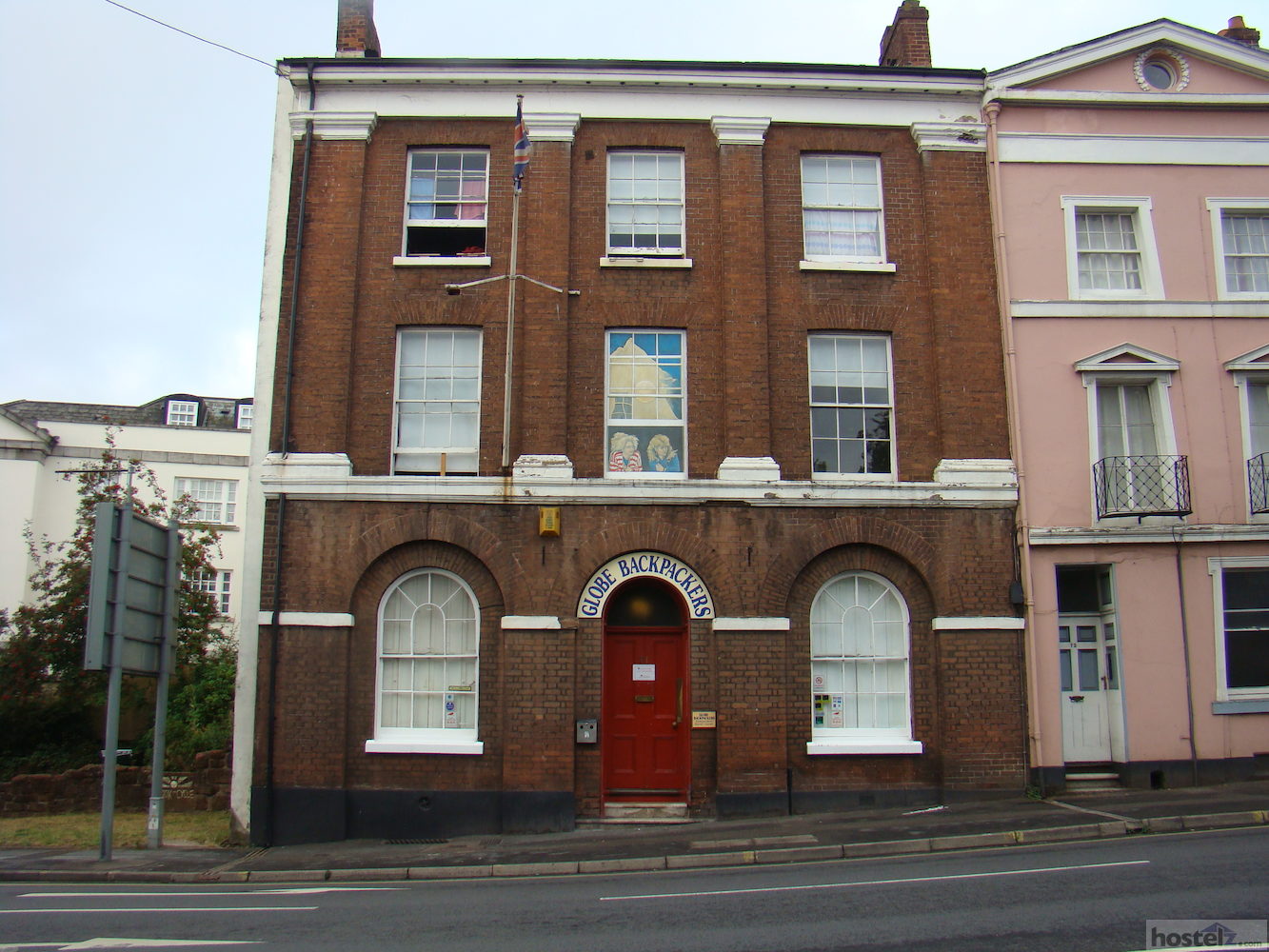
Holloway Street boasts a variation on the theme of painted glass panes with the trompe l’oeil picture of two girls looking out of a window.  The blind windows of the Barnfield Theatre have been decorated, some with trompe l’oeil – theatres and cinemas do not generally have windows.

At the junction of Fleming Way with Barrack Road, on the old Princess Elizabeth hospital site, there are two curved terraces of modern town-houses.  On the ends are fake windows, recesses in the brickwork with a white head and a small sill.  They are there for the sake of appearance, but are not very convincing.  Because the outer skin of the cavity wall is quite thin, the recess has to be shallow to maintain the insulation of the building.  Builders use such fakes so that the interior of the house has large expanses where wall-mounted furniture can be placed.  But I loved the final comment of one writer explaining why there are blind windows on such modern estates; he wrote: “The builder was waiting for delivery of the window frames, and gave up because it was taking too long”.  
 Printed in St Leonard's Neighbourhood News. November-December 2016
 
Keywords: St Leonards, Exeter, history, geography, beauty, windows