Magdalen Road at night

Magdalen Road at night
December 2010

Tuesday, 14 March 2023

A second walk along the walls (2023)

In the first of these walks, we went as far as Matford Lane along Wonford Road.  In the slightly warmer months of spring, we’ll go eastwards along Wonford Road to Barrack Road.  As I pointed out in the first article, until the 20th century, traffic flowed from Matford Lane into the east end of Wonford Road.  After Lyndhurst Road, the walls on the left illustrate three different approaches to using Heavitree Breccia (the sandy stone); the walls were the boundaries of three 19th century properties.  First a very well made wall of regular blocks from the local quarries --- regular meaning rectangular, even if not all the same size.  Past the gate, to the second property wall, and there are several very small “filler” blocks.  But the sad aspect of this wall is that the mortar has been repaired with a very hard concrete, which has led to damaged stones; water has been trapped behind the tough material, eroding the sandy material.  (On the opposite side of the road is the coach house of Lahill; the house was lost in the Second World War, and there are a few fragments of the stones of its boundary walls.)  The third part of the wall on the left of Wonford Road used lower quality stones and this material has been shaped by rainwater and the splashes from traffic in rainstorms.  The result is an irregular surface. 

Water splashes have created holes in the wall ---sometimes used for birds' nests

It is worth walking a short way along the two side roads here.  To the left, Victoria Park Road runs between two 19th century properties; on the left is Magdalen Court School, built around “Fairhill”.  Parts of its walls survive, most notably at the north end of the property, where there are stones from a rougher wall.  Turn round here, and look past the cricket pavilion to see the raised glass canopy of the structure In the grounds of Larkby --- a Victorian racquets court, a grade II listed building.  Once back at the junction, take a look down Matford Avenue.  On the left, there is an Edwardian brick wall, which provides a uniform front to the properties.  Opposite, the two blocks of 1930s semi-detached houses have a stone wall; it has been built with much smaller stones than those on the main road and show a range of types of stone, mainly Breccia and Pocombe stone, but with occasional pieces of trap and granite…probably what the builder had in his stock.  The smaller stones in these walls could be laid by one person; that’s not possible with the larger blocks in the older walls.

Larkby’s wall facing Wonford Road uses good quality Breccia, but even this may be eroded as can be seen at the corner by the postbox (installed in the reign of Edward 7th, reflecting the business from the increased number of local houses) and in patches further along.  Mardon House is built on the site of Matford Lodge, the lodge building for the eastern half of today’s Larkby Centre and its wall continues the Breccia --- but this section shows less attention to maintenance.  Further along, on the right is Old Matford with a 400-year old cob wall topped with tiles and protected against the weather with porous rendering.  The opposite side of road sees a sudden transition of material and quality.   

Irregular filling on the left

 Why?  Have a look at the kerbstones of the pavement; they are dropped, because this was a field entrance until after the Second World War, leading into the allotments which existed before the development of the Nuffield Hospital.  The walls look as if they have been formed from a heap of odd blocks --- put together with care, but not for aesthetics!  A little further, a second dropped kerb marks another former gateway, but the filling here is significantly better.   

Neat filling on the left

The stone wall comes to an end at the small stream just before the hospital entrance.  From the end of the Larkby wall to here, the original walls are well-built, but use a wider range of quarried stones than those used for the fine houses earlier.  Appearance was not so important for small-holders.
Entrance to Gras Lawn

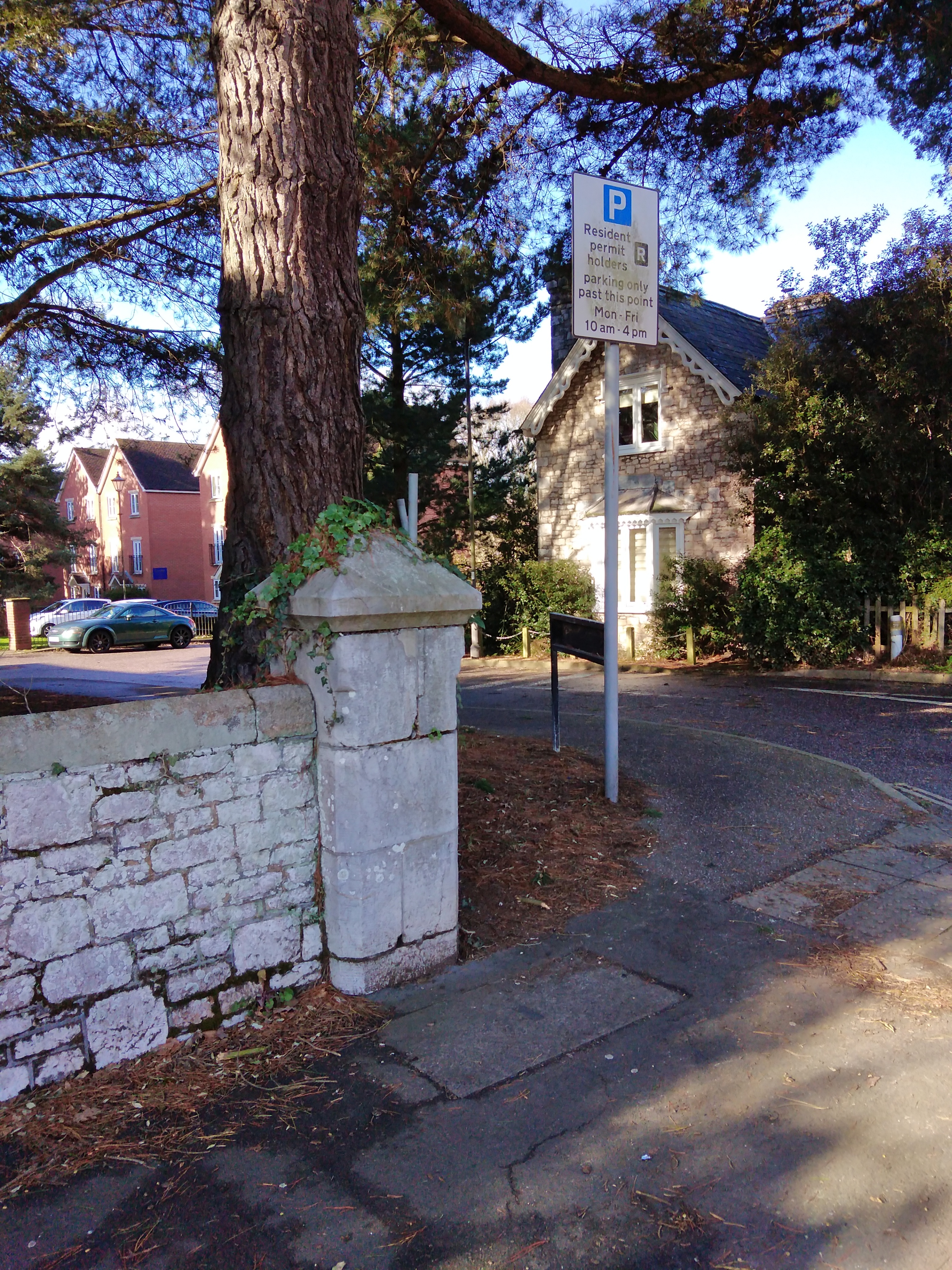
Beyond the stream the old walls have been lost to development, but on the opposite side of the road are the limestone walls and lodge of Gras Lawn, the former home of members of the Veitch family.  It was a modest home, and the modesty extended to the small gateposts.  Barrack Road’s walls are a mixture from several eras and have been much altered over the 20th century.

Next issue we’ll explore some different walls.

David Smith  (http://lookatstls.blogspot.com/)

Keywords: St Leonards, Exeter, history, geography, beauty


Monday, 16 January 2023

Walk along the Walls of St Leonard's

Several years ago, I wrote a series of articles for the St Leonard's Neighbourhood News inviting you to look around at some of the interesting and unusual features of St Leonard’s.  One of those was a brief introduction to the stones of the area.  And that led to a puzzled resident curious about the flint nodules in her garden – imported from a long way away to be decorative!

Come with me on a winter walk to look in more detail at how local stones have contributed to the street scene of the neighbourhood.  It’s easy to recognise five types of stone to be seen when you are walking along our streets and roads, without looking for decorative rocks from outside Devon.  Most obvious is granite, from Dartmoor.  And then there are lots of examples of Heavitree sandstone (Breccia) from the quarries of the Broadfields estate (which is why there is Quarry Lane there!).  Also quite common are examples of Pocombe stone, from the ridge of the hills above St Thomas, particularly from the site of park homes at the top of Dunsford Hill; you can spot this material as it is a grey with a hint of purple, streaked with white.  Volcanic trap, a very hard dark stone, much used in the walls of the city, is found in a few places, and so are blocks of limestone, some quarried from the quarries at Beer. 

Walk with me along St Leonard’s Road, heading south from the traffic lights.  Here are the houses of affluent Victorians, with gardens fronted by walls topped with granite.  Many of the granite blocks carry the marks of former iron railings, cut away to supply metal during World War 2.  There are some granite gateposts as well.   


There were stonemasons working around Exeter, some on the Quay, in the 19th and early 20th centuries, who supplied the Dartmoor granite.  It had travelled by rail, (or a combination of rail and sea) from the moor, much of it shaped there. Walkers on the moor today can find blocks which are, for some reason, shaped but unfinished.  The stones had to be transported from the stonemasons’ yards to St Leonard’s by horse-drawn cart and then manhandled into place.  As a result, granite was an expensive material, appropriate for these houses.. 

Look up into Premier Place, where the wall on the right (25 St Leonard’s Road) is a rough wall of assorted stone, with a lot of nice Pocombe pieces.  The mortar between the stones shows a variety of styles; masons have their own styles for wall-building and repairing.  At the far end of the property, there’s some 19th century Heavitree breccia.  Beyond this there has been much rebuilding since the 1940s


Turn into Wonford Road, and on the left is a small low wall built of scrap stones, collected from the ruined walls after the 1942 bombing. Immediately afterwards, in the brick wall, there is a post-box from the reign of George VI, replacing one lost in the same destruction.  Opposite, at the junction with Park Place, there is a stone placed to force wagon wheels away from the wall.   


Old pieces of Heavitree stone make a low wall on the left, one of the few reminders of the older walls of this section of the road.  Before Lyndhurst Road, there is one older wall on the left, with modern brick pillars at the gates.  It’s the first example of a type of wall that is common in the city, built very carefully with an assortment of stones of many shapes and sizes.  Quarried stone, apart from granite, was cheap, and Victorian masons would have used whatever came to hand when constructing walls for front gardens.

The junction of Wonford Road with Matford Lane and Lyndhurst Road marks the start of a transition from urban to rural ---at least as far as walls go.  Until the mid 20th century, Matford Lane merged on a curve into Wonford Road as the through route.  You can trace the former route in the bushes on the corner.

In the next issue we’ll explore the walls in Wonford Road beyond here.

David Smith 

Keywords: St Leonards, Exeter, history, geography, beauty 

Sunday, 22 March 2020

Signs of the times (Before and during Lockdown 2020)


Where someone has guerrilla gardened in St Leonard's

Spring is around the corner


In Denmark Road


Shop window in the "Village"

Corvid - 19 is around the corner 

And a few days later ... lockdown


Keywords: St Leonards, Exeter, history, geography, beauty 


Thursday, 16 January 2020

Christmas Fair in Magdalen Road, December 7th 2019

Entertainment for the younger visitors 


Crowds thronging the car-free space

Musical entertainment

Two affordable houses in St Leonard's - but not much space inside


Assorted food for everyone


Ready to sell Christmas trees 

Saturday, 13 July 2019

Look at the Breccia in St Leonard’s

What’s breccia?  It’s the geologist’s name for Heavitree stone, and there’s a lot of it about.  It’s used for buildings and for walls all over the city, because it is conveniently to hand.  (If you were building a house, and all the materials came in a horse-drawn cart, you would use local materials!)  And, because it was cheap, and found in quantity nearby, many walls around St Leonard’s have foundations of breccia, and – more expensive and posher – bricks to finish the upper layers.  However, it is a coarse sandstone, and is prone to weathering, so that some examples around the neighbourhood are crumbling to dust.  (Cars and large vehicles throw up water from puddles more vigorously than humans and horses.) 

Our friends in Heavitree are celebrating their local stone, with a website called Heavitree quarry trails.  It has three suggested routes for looking at constructions made with the stone, and a photo gallery (including the city council’s reserve stock of the material which is on Belle Isle).  

There’s also a challenge with an A to Z of sites in Exeter where there is Heavitree stone in use.  The suggestion is that you should spell out your name by visiting each letter in turn.  So here is the list for Leonard:

L is St Loye’s Chapel in Rifford Road
E is St Edmund’s Church on the old Exe bridge
O is Old Deanery wall near Exeter Cathedral
N is Benedictine Priory of St Nicholas
A is St Anne’s Orthodox Church
R is Rougemont Castle
D is Devon and Exeter Institution

Look out for this site and plan your own walk looking at breccia in the city!

Published in July-August 2019 issue of Neighbourhood News 
 
Keywords: St Leonards, Exeter, history, geography, beauty